
Is It Worth It: Adding an Accessory Dwelling Unit

MARCH 16, 2026
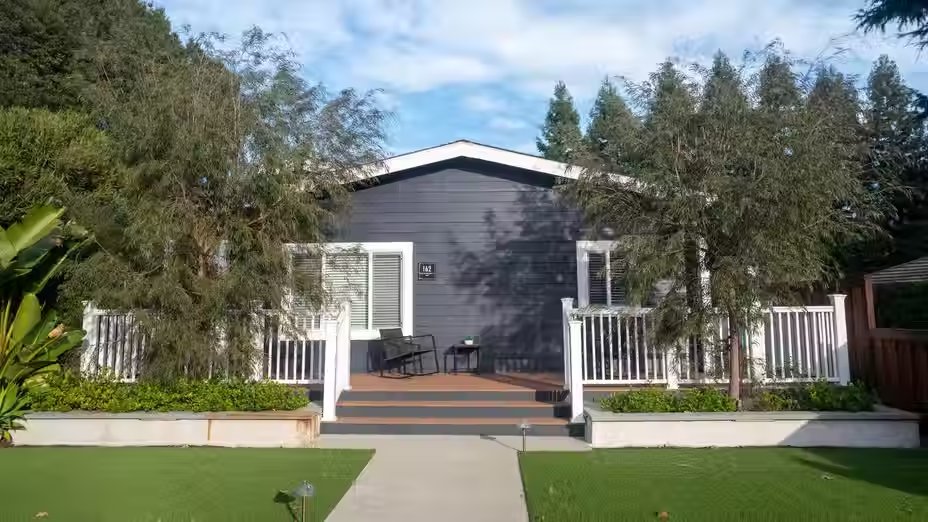
An ADU, or accessory dwelling unit, is an increasingly popular solution for a range of homeowner needs. Want a separate space for a home office or studio? A place for aging parents or adult kids to live close by—but not too close? A rental unit to bring in extra income? Adding an ADU may be the answer.
Relatively affordable and highly adaptable, these mini-homes are popping up everywhere — especially in California, where lawmakers have loosened regulations to encourage ADU construction and help address housing shortages. Interest has also surged since COVID transformed how many people live and work at home.
But, is adding an ADU actually worth it? We spoke with real estate agents and homeowners about the pros and cons.
Meet the experts
Andy Brohard, a homeowner in Los Angeles, CA
Tony Aguirre, a real estate agent in Las Vegas, NV
Ashley Meredith, a real estate agent in Greensboro, NC
Tammy Young, a real estate agent in Austin, TX
What is an ADU?
If you’re wondering what exactly an ADU is, you’re not alone. But you probably have heard the term “mother-in-law suite” or, perhaps, “granny flat.” They are one and the same.
According to the U.S. Department of Housing and Urban Development, ADUs are “additional living quarters on single-family lots that are independent of the primary dwelling unit.” They can be attached or detached and may have separate kitchens and bathrooms, but they cannot be sold separately.
Is an ADU a good source of rental income?
If rental income (and cash flow) is your goal, an ADU is certainly worth considering.
“It’s the cheapest way to get a rental property,” says Brohard, who spent eight months converting his two-car garage into a one-bedroom, one-bathroom long-term rental.
And Aguirre agrees, explaining: "You could potentially pay the mortgage with just your mother-in-law suite."
How much rental income can I expect?
The 2% rule in real estate investing states that monthly rent should be at least 2% of the purchase or build price in order to be considered a good value. So, for example, if it costs $90,000 to build a 600 square-foot ADU, the monthly rent would need to be at least $1,800.
Will adding an ADU increase the value of your home?
Our experts agree: It’s unlikely that an ADU will add anything to the assessed or appraised value of a home. In Greensboro, NC, for example, Meredith says that an ADU adds zero assessed value to a home.
“I had to be careful when I recently listed this property with an ADU,” she says. “We worded it very carefully: ‘The ADU is located on property and is being sold at no additional value.’”
Likewise, in Austin, TX, Young says that ADUs add little to no value. “Newer agents are quick to give the back house the same value as the front, and it just won’t appraise,” says Young, who has 15 years of experience selling real estate.
Will adding an ADU make your home more attractive to buyers?
An ADU isn’t without value. “It’s like a pool,” Aguirre says. “A pool only adds $15,000-$25,000 in assessed value, but that’s nowhere near the value that a buyer who wants a pool puts on it.”
What kind of approvals are necessary before building an ADU?
Anyone considering building needs to first check their city and even neighborhood ordinance. One neighborhood could be zoned for ADUs, while the next street or subdivision over may not allow them. A house sitting on a 7,000-square-foot lot may legally contain an ADU, whereas a home sitting on 6,000 square feet may not. Consider, too, that your city may also limit the square footage of an allowable ADU.
So, is adding an ADU worth it?
Adding an ADU can open the door to rental income, flexible living space, and greater buyer interest when it’s time to sell. But zoning rules, construction costs, and limited appraisal value mean it’s not a guaranteed win. As with most home projects, the real question isn’t just can you build one—it’s whether an ADU makes sense for your property, your finances, and how you plan to use the space.
.
Would you consider an ADU
Yes?
NO?


Comments